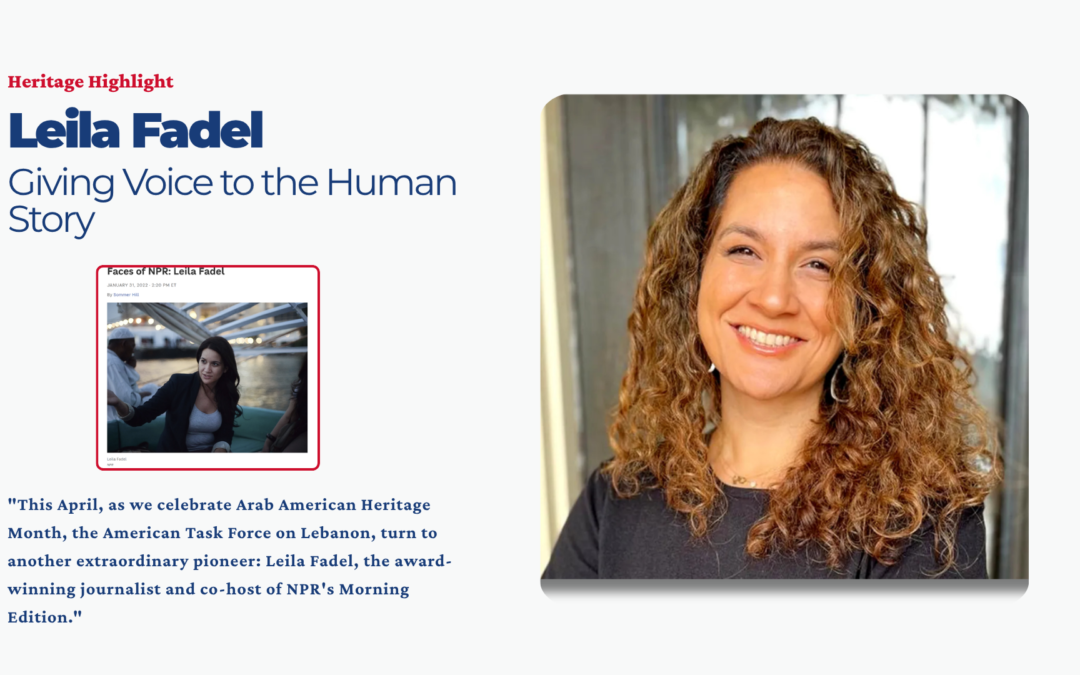
Born in Lebanon and raised between Lebanon and Saudi Arabia. Watching one-dimensional media coverage of the region inspired her to become a journalist to tell the true human story.
In the fast-paced world of daily news, it is easy for the human element to get lost behind geopolitical headlines and statistics. But for journalists like Leila Fadel, the human story is the only one that truly matters. By bringing deep empathy, cultural fluency, and an unwavering commitment to truth to her reporting, she has fundamentally reshaped how Americans understand both the Middle East and their own communities.
This April, as we celebrate Arab American Heritage Month, the American Task Force on Lebanon (ATFL) is proud to continue our “Heritage Highlights” series, dedicated to reclaiming and celebrating the stories of Lebanese-Americans who have left an indelible mark on the fabric of our nation. Following our highlight of Reem Acra, we turn to another extraordinary pioneer: Leila Fadel, the award-winning journalist and co-host of NPR's Morning Edition.
The Roots of a Truth-Seeker
Born in Lebanon in 1981, Leila Fadel spent her childhood moving between Lebanon and Saudi Arabia. Growing up, she watched American media coverage of the Gulf War and the Lebanese Civil War and realized that the people on her screen did not look or sound like the people she knew. She witnessed a complex, rich region reduced to two-dimensional stereotypes and conflict.
Driven by a profound desire to bring nuance and humanity to these narratives, she set her sights on journalism. She aimed to get into the industry to fill the gaps in mainstream reporting and stop the oversimplification of Arab lives. This mission led her to Northeastern University in Boston, where she graduated from the School of Journalism in 2004, ready to change the narrative.
From the Frontlines to the Heart of the Story
Fadel’s career quickly propelled her to some of the most dangerous and complex reporting environments in the world. By 2005, she was on the ground covering the devastating human toll of the Iraq War for Knight Ridder and later McClatchy Newspapers. Rather than focusing solely on military tactics, she centered her reporting on the civilians caught in the crossfire. Her chilling, first-hand accounts of the violence earned her the prestigious George Polk Award for Foreign Reporting in 2007.
In 2010, she joined The Washington Post as the Cairo Bureau Chief, where she provided vital, on-the-ground coverage of the Arab Spring and its aftermath across Egypt, Libya, Tunisia, and Syria. Her fluency in Arabic and deep cultural understanding allowed her to bypass official spokespeople and speak directly to the citizens driving the revolutions, bringing their unfiltered hopes and struggles directly to American readers.
A Trusted Voice for the Nation
In 2012, Fadel brought her international expertise to National Public Radio (NPR) as their Cairo Bureau Chief. Upon returning to the United States, she shifted her focus to domestic issues, serving as a national correspondent covering race, diversity, and culture during some of the most tumultuous periods in recent American history.
Today, she serves as a co-host of NPR’s flagship programs, Morning Edition and Up First. Every morning, millions of Americans wake up to her voice. As a Lebanese-American woman anchoring one of the most widely listened-to news broadcasts in the country, Leila Fadel continues to champion empathetic, deeply human journalism, ensuring that the voices of the unheard are broadcast loud and clear.
Voices on Her
Northeastern University President Joseph E. Aoun:
“An authentic storyteller, Leila Fadel has shared the experiences of countless people around the world while enriching the lives of many more with her reporting. Fadel’s award-winning work dives deep into complex stories that might otherwise be oversimplified.”
Long Island University (The George Polk Awards):
Honored with the George Polk Award for her "chilling, first-hand accounts of ethnically inspired violence and murder in Iraq," recognizing her fearless dedication to highlighting the devastating human toll of the conflict.
Leila Fadel (On Her Approach to Journalism):
“My goal is to find the missing voices... Great journalism is the ability to capture moments in time, weave them together, and tell the story of all people without condescension, without judgment and without an agenda.”