
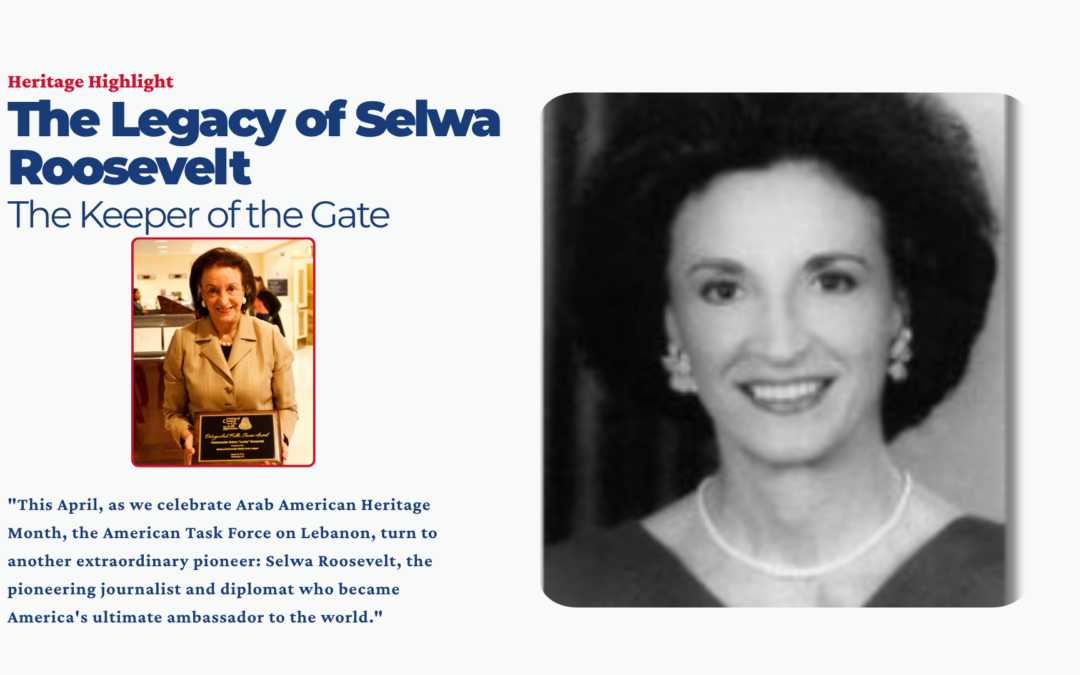
Born Selwa Carmen Showker in Kingsport, Tennessee, the proud daughter of Lebanese Druze immigrants.
When we think of international diplomacy, we often think of treaties and formal negotiations. Yet, the true foundation of global relations is built on hospitality, cultural fluency, and human connection. Few individuals in American history have mastered this delicate art quite like Selwa "Lucky" Roosevelt. As the longest-serving Chief of Protocol of the United States, she brought the legendary warmth and hospitality of her Lebanese heritage to the very center of American power.
This April, as we celebrate Arab American Heritage Month, the American Task Force on Lebanon (ATFL) is proud to continue our “Heritage Highlights” series, dedicated to reclaiming and celebrating the stories of Lebanese-Americans who have left an indelible mark on the fabric of our nation. Following our highlight of Leila Fadel, we turn to another extraordinary pioneer: Selwa Roosevelt, the pioneering journalist and diplomat who became America's ultimate ambassador to the world.
The Roots of a Diplomat
Born Selwa Carmen Showker on January 13, 1929, in Kingsport, Tennessee, she was the daughter of Salim and Najla Showker, proud Lebanese Druze immigrants. Growing up in a small southern town, Selwa's childhood was deeply shaped by her parents, who instilled in her a profound appreciation for their ancestral roots in the mountain village of Arsoun, Lebanon, while fully embracing the American dream.
A brilliant student, she graduated as the valedictorian of her high school class and went on to earn honors in international relations at Vassar College in 1950. Shortly after graduating, she married Archibald B. Roosevelt, Jr., a grandson of President Theodore Roosevelt. While her marriage brought her into one of America's most famous political dynasties, Selwa carved out her own formidable career as an accomplished journalist for The Washington Evening Star, Town & Country, and Family Circle, covering the diplomatic corps and international relations.
Reimagining the Boundaries of American Protocol
In 1982, President Ronald Reagan appointed Selwa Roosevelt as the Chief of Protocol of the United States, granting her the rank of Ambassador. In this vital role, she became the "Keeper of the Gate," responsible for advising the President on national and international diplomatic etiquette and serving as America's official hostess to visiting heads of state.
During her nearly seven-year tenure—the longest of anyone to hold the position—she organized more than 1,000 visits from world leaders, kings, queens, and prime ministers. Roosevelt seamlessly utilized her Lebanese cultural heritage, known for its deep traditions of hospitality, tact, and cross-cultural understanding, to navigate the highly complex, often Byzantine halls of diplomatic Washington.
A Builder of Institutions and a Savior of History
Ambassador Roosevelt did not merely manage events; she preserved American history. Upon taking office, she recognized that Blair House, the President's official guest house for foreign dignitaries, was in a severe state of disrepair. Spearheading a massive, multi-million dollar public-private fundraising initiative, she oversaw the meticulous six-year restoration of the 110-room historic complex, ensuring that the United States had a world-class residence to welcome global leaders.
In 1990, she published her critically acclaimed memoir, Keeper of the Gate, documenting her extraordinary journey from a daughter of Lebanese immigrants to the heart of the White House. Today, she remains a towering figure in American diplomacy, proving that the integration of Arab American cultural values into public service can leave a profound, lasting legacy on the world stage.
Voices on Her Legacy
Arab America (Highlighting her Cultural Roots):
"I didn't feel foreign. I felt foreign in my looks because I'm dark and have a definite Middle Eastern look. But I never felt in my soul that I was any different... My parents were from the Druze — the tribes that were really sort of an aristocracy of Lebanon at one time. They held the balance of power between the Christians and Moslems and the Druze are very special. They have a great history, they think, and they are proud people like mountain people everywhere."
U.S. Global Leadership Coalition
“She was appointed by President Reagan to serve as Chief of Protocol of the United States in 1982 and held this position for almost seven years, longer than any other person has held that position.”
Official White House Recognition
“The President signed a presidential commendation in honor of Roosevelt’s government service.”
