A Journey Begins
Born in Rashayya al-Wadi, Lebanon, Alixa immigrated to the United States as a toddler, eventually settling in the Midwest where her father worked as a peddler.
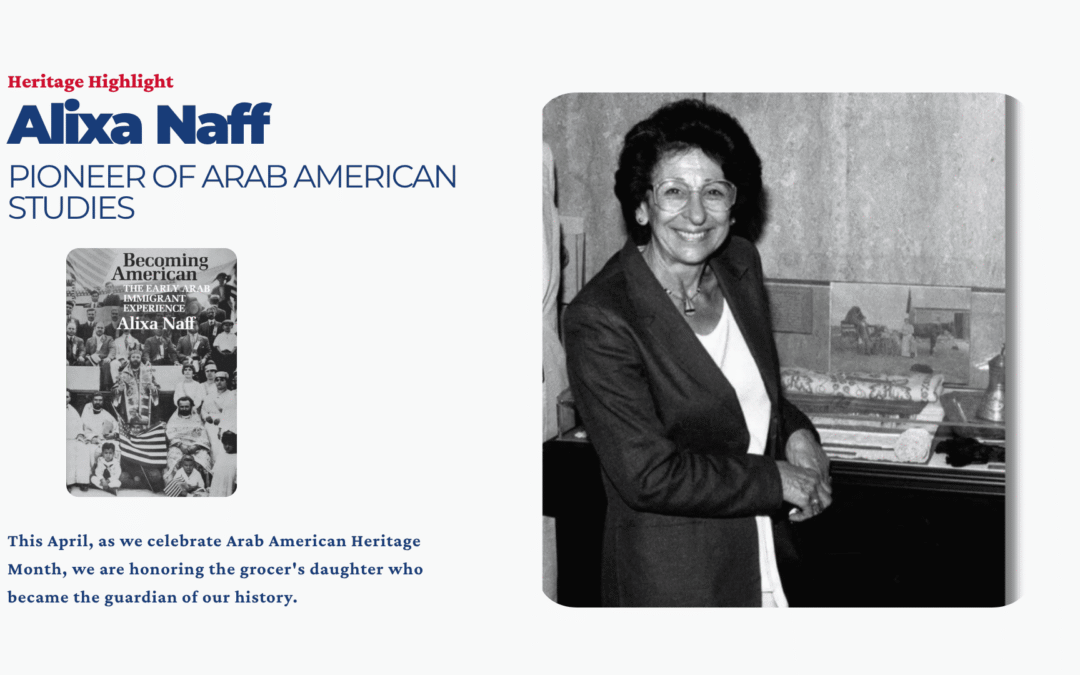
In the early 1960s, a blue Volkswagen Beetle nicknamed "The Camel" hummed across the American highways, driven by a woman with a cassette recorder and a desperate mission. Dr. Alixa Naff had realized a heartbreaking truth: the history of the first generation of Arab immigrants was being thrown away. Every time an elder passed away and their children cleared out an attic, letters, photographs, and memories were ending up in the trash. She knew that if someone didn’t act immediately, the story of how the Lebanese and Arab diaspora helped build America would vanish forever.
This April, as we celebrate Arab American Heritage Month, the American Task Force on Lebanon (ATFL) is proud to launch our "Heritage Highlights" series. This initiative is dedicated to reclaiming and celebrating the stories of Lebanese-Americans who have left an indelible mark on the fabric of the United States. We begin with the woman who quite literally wrote the book on our history: the legendary Dr. Alixa Naff.
The Life and Legacy of a Pioneer
Alixa Naff was born in 1919 in Rashayya al-Wadi, Lebanon, and arrived in the U.S. as a toddler. Growing up in the Midwest during the Great Depression, she lived the quintessential immigrant experience, working in her father’s grocery store and navigating the complex pull between her Lebanese roots and her American surroundings. It wasn't until her late 30s that she pursued higher education, eventually discovering a staggering "academic silence" regarding Arab American history.
In 1962, Naff took matters into her own hands. With a small grant and her trusted "Camel," she tracked down 87 elders across 16 communities. She recorded their voices, saved their peddling trunks, and preserved their family bibles. Her groundbreaking 1985 book, Becoming American: The Early Arab Immigrant Experience, transformed these scattered memories into a formal academic discipline. In 1984, she ensured these stories would live in the heart of the American narrative by donating her massive collection to the Smithsonian Institution.
Voices on Her Legacy
Dr. Naff’s work has been recognized by the most prestigious institutions in the world. Here is how she is remembered by those who continue her work:
Middle East Research and Information Project (MERIP)
"Naff has reconstructed this bygone world from scraps of memories culled from extensive oral interviews with some of the old-timers and their descendants."
The Khayrallah Center for Lebanese Diaspora Studies:
"A founder of Arab American Studies... she discovered the mother lode of Arab life histories."
The Smithsonian Institution:
"Alixa Naff breathed life into the invisible... her archive established the Faris and Yamna Naff Arab American Collection to encourage ongoing research."
National Museum of American History:
“Collection documents the early Arab immigrant experience and assimilation in the United States dating from circa 1880 through World War II. It is the direct result of research conducted by Dr. Alixa Naff beginning in 1962 with oral history interviews. Her study developed into a major project in 1980 with funding from the National Endowment for the Humanities (NEH) and a book Becoming American: The Early Arab Immigrant Experience published in 1985.”