The Full Picture: How We Imagine the Future
Fragmenting Lebanon’s future into separate pieces will not resolve the challenges experienced by Lebanese on the ground.
A family displaced from the South asks not only for shelter but also for the state to ensure their safety, provide public services, and prevent escalations from undoing their lives again.
An investor seeks not only opportunity, but also banks, regulations, and institutions they can trust.
The youth question not their love for the country, but whether the state can give them enough reason to stay.
This is why ATFL views the future of Lebanon as a full picture. Peace, sovereignty, state authority, support for the LAF, reform, recovery, and diaspora solidarity are pieces of the same puzzle.
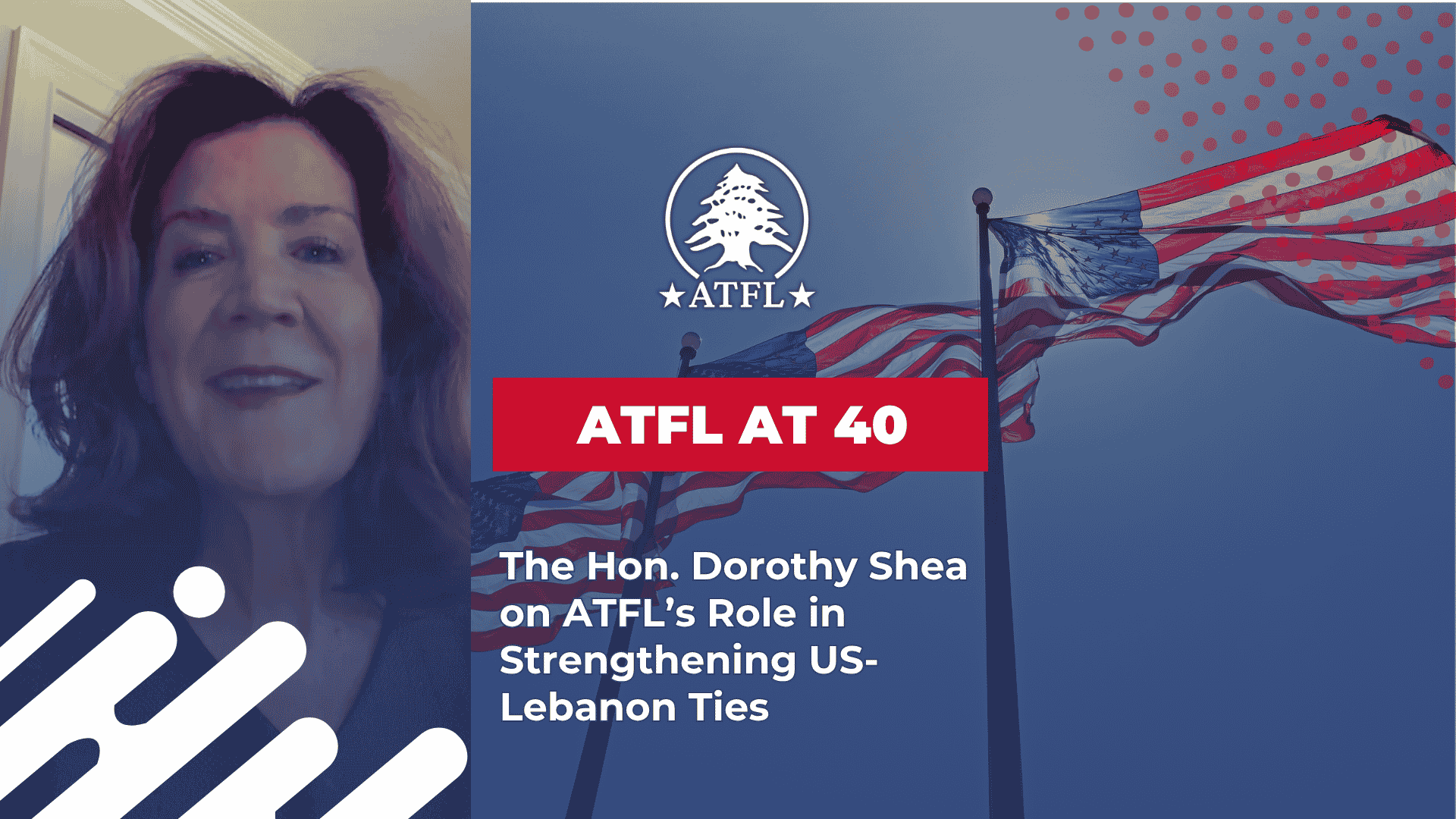
The Hon. Dorothy Shea on ATFL’s Role in Strengthening US-Lebanon Ties
In a support message, the Hon. Dorothy Shea, former US Ambassador to Lebanon, reflects on ATFL’s role in building bridges between the United States and Lebanon. Recalling ATFL’s humanitarian response following the August 4, 2020 Beirut Port explosion, she highlights how the organization helped turn the strength of the US-Lebanon relationship into tangible support at a moment of extraordinary need.
A Broad Tent: Bringing Lebanese Americans Together for a Shared Mission
For generations, Lebanese Americans have helped build and strengthen the United States. They have created businesses, cared for patients, taught in schools and universities, served in government and the military, led community institutions, and contributed to cities and towns across the country.
They are proud Americans who care deeply about the country they call home. Many also carry a strong connection to Lebanon and believe that the relationship between the United States and Lebanon matters.

Policy Over Partisanship: ATFL’s Vision for a Sovereign and Prosperous Lebanon
As an independent, non-partisan, and non-sectarian organization, ATFL works to educate policymakers and the public about the importance of a strong US-Lebanon relationship. Being policy-focused means that ATFL’s positions are guided by facts, strategic priorities, institutional needs, and measurable outcomes, rather than loyalty to a political party, sect, individual leader, or electoral agenda.

The Foundation of Recovery: Reconstruction, Reform, and Investment
Lebanon’s reconstruction challenge is urgent. Affected communities, especially in the South, need immediate support: homes repaired, services restored, schools and hospitals reopened, and local economies brought back to life.
But reconstruction alone will not be enough.
According to the World Bank, Lebanon’s post-conflict recovery and reconstruction needs are estimated at $11 billion, with housing, businesses, public services, infrastructure, health, education, and agriculture all affected.

Sovereignty Is Not Abstract: Why State Authority Matters for Lebanon’s Future
Sovereignty is often discussed as a national principle, a diplomatic goal, or a security concern. But for Lebanese citizens, sovereignty is not abstract. It shapes daily life.
It affects whether families feel safe in their towns and villages. It affects whether young people believe they can build a future at home. It affects whether investors trust the country enough to create jobs. It affects whether schools, hospitals, roads, water networks, electricity, and telecommunications can be restored and protected. Ultimately, it affects whether Lebanon can recover with dignity and confidence.

Lebanon’s Economic Crisis: Understanding IMF Requirements and Banking Reform
The structural collapse of the banking sector has forced Lebanon into a parallel cash economy, which now accounts for an estimated 45.7% of the country’s GDP. In April 2022, the Lebanese government reached a Staff-Level Agreement (SLA) with the International Monetary Fund (IMF) for a $3 billion Extended Fund Facility. However, accessing these funds requires strict adherence to a framework of prior actions known as IMF conditionality.

Unpacking Lebanon’s Parallel Cash Economy: The Collapse of Trust and the Path to Recovery
Lebanon’s financial sector was once the bedrock of its economy, attracting regional capital and serving as the financial hub of the Levant. Today, the country operates almost entirely as a parallel cash economy. This transformation was not a sudden accident, but the result of a profound structural collapse that fundamentally severed the social contract between Lebanese citizens, their financial institutions, and the state.
Understanding how this happened, and why a cash-based system critically limits Lebanon’s future, is essential for charting a viable path forward.
Understanding UNSCR 1701: The History and the 2026 Path Forward
With the recent high-level talks in Washington D.C. dominating the news cycle, one term continues to surface as the ultimate roadmap for a permanent ceasefire: UN Security Council Resolution (UNSCR) 1701.
But what exactly does a resolution from nearly two decades ago have to do with the complex diplomacy happening today?
At the American Task Force on Lebanon (ATFL), we regularly brief U.S. policymakers and congressional staff on the issues shaping U.S.-Lebanese relations. As a non-partisan, non-sectarian, and independent organization, we aim to provide fact-based analysis and clear context on the developments that matter most. Through this Explainer series, we break down complex issues into accessible insights for a broader audience.