
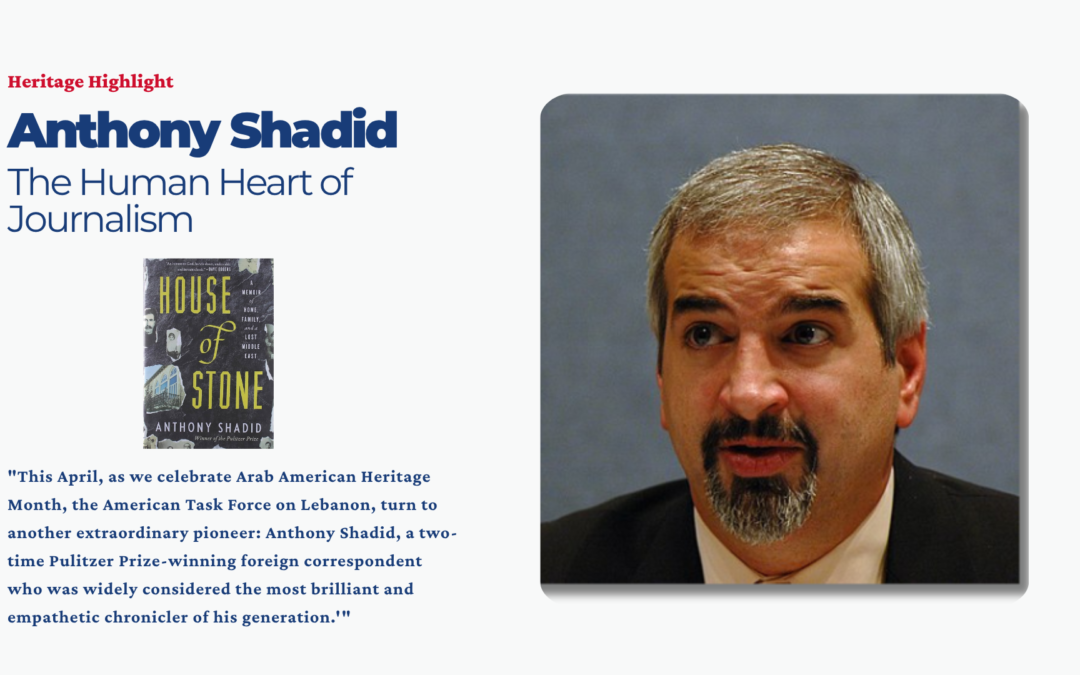
Born in Oklahoma City, Oklahoma, to a Lebanese-American family whose roots trace back to Marjayoun in southern Lebanon.
When history is written, it is often recorded in terms of dates, borders, and political maneuvers. But occasionally, a journalist comes along who insists that history must be recorded through the eyes of the people living it. This is the enduring legacy of Anthony Shadid, a man who bypassed official spokespeople to sit in the living rooms of the Middle East, forever changing how Americans understood the region.
This April, as we celebrate Arab American Heritage Month, the American Task Force on Lebanon (ATFL) is proud to continue our “Heritage Highlights” series, dedicated to reclaiming and celebrating the stories of Lebanese-Americans who have left an indelible mark on the fabric of our nation. Following our highlight of Dr. Michael DeBakey, we turn to another extraordinary pioneer: Anthony Shadid, a two-time Pulitzer Prize-winning foreign correspondent who was widely considered the most brilliant and empathetic chronicler of his generation.
The Roots of a Storyteller
Born on September 26, 1968, in Oklahoma City, Anthony Shadid was raised in a Lebanese-American family with deep roots tracing back to Marjayoun, a historic town in southern Lebanon. Growing up in Oklahoma, he was profoundly shaped by his family’s rich cultural heritage. From a young age, he exhibited a deep curiosity about the world and a frustration with how the Middle East was portrayed in American media.
That determination to seek authentic narratives led him to the University of Wisconsin-Madison, where he laid the foundation for a legendary journalism career. He embarked on a path that took him from the Associated Press to The Boston Globe, The Washington Post, and eventually The New York Times, always driven by a singular goal: to understand people’s humanity and keep it at the center of his stories.
Reimagining the Boundaries of Journalism
Shadid’s contributions to foreign correspondence were extraordinary in both scale and impact. In a field where war reporting often focused on military strategy and frontline combat, Shadid pioneered a radically different approach. Fluent in Arabic, he possessed an unmatched ability to capture the profound human cost of conflict.
He preferred to wander neighborhoods and work local leads, recognizing that the truest stories lay everywhere people lived and worked. By listening to the poetic, tragic, and resilient voices of ordinary citizens in Baghdad, Beirut, and Cairo, he brought unprecedented empathy to American journalism. His groundbreaking, on-the-ground reporting during the Iraq War and its aftermath earned him two Pulitzer Prizes for International Reporting, cementing his status as a titan of the press.
A Builder of Understanding and a "House of Stone"
Despite his global travels, Shadid’s heart remained deeply tethered to his ancestral home. He did not just report on the Middle East; he sought to preserve its history and beauty. In 2007, during a period of personal exhaustion, he took a leave of absence to return to Marjayoun, Lebanon. There, he spent a year painstakingly rebuilding his great-grandfather’s abandoned, war-damaged estate.
He documented this profound journey in his critically acclaimed memoir, House of Stone. The book serves as a magnificent love letter to Lebanon, exploring the enduring power of heritage, the trauma of the diaspora, and the physical act of rebuilding a fractured identity. Tragically, Shadid passed away in 2012 while on assignment in Syria, but his work continues to bridge the gap of understanding between two worlds, reminding us that behind every geopolitical headline is a human heartbeat.
Voices on His Legacy
Jill Abramson, Former Executive Editor of The New York Times:
“Anthony died as he lived — determined to bear witness to the transformation sweeping the Middle East and to testify to the suffering of people caught between government oppression and opposition forces.”
Phil Bennett, Former Managing Editor of The Washington Post:
“Anthony showed us—reminded us—how a lone reporter can transform our understanding of history by revealing something true of human experience.”
Columbia Journalism Review:
“The most honored foreign correspondent of his generation.”