
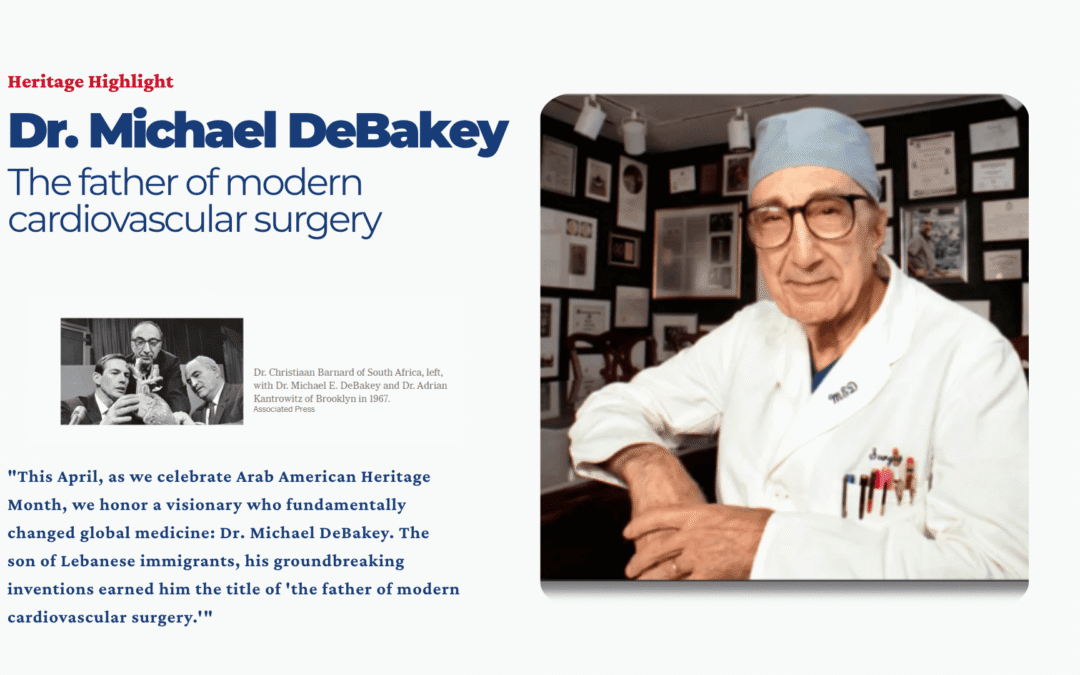
Born in Lake Charles, Louisiana, to Shaker and Raheeja Dabaghi, Lebanese immigrants who managed a local pharmacy.
Before modern cardiovascular surgery changed what was possible, a failing heart often meant there was little medicine could do. The operating room had limits. Survival had limits. Hope had limits. Then came Dr. Michael DeBakey, the son of Lebanese immigrants, whose brilliance, discipline, and relentless commitment to healing helped transform those limits into possibilities for millions of people around the world. (profiles.nlm.nih.gov)
This April, as we celebrate Arab American Heritage Month, the American Task Force on Lebanon (ATFL) is proud to continue our “Heritage Highlights” series, dedicated to reclaiming and celebrating the stories of Lebanese-Americans who have left an indelible mark on the fabric of our nation. Following our highlight of Dr. Rosa Lee Nemir, we turn to another extraordinary pioneer: Dr. Michael DeBakey, a surgeon, educator, and medical statesman whose work helped redefine modern medicine.
A Young Mind with Steady Hands
Born on September 7, 1908, in Lake Charles, Louisiana, Michael DeBakey was the oldest child of Lebanese immigrants Shaker Morris and Raheeja Dabaghi. He grew up in a family that valued learning, discipline, and service. His father operated drugstores, and his mother, an accomplished seamstress, taught him the precision of working with his hands, a skill that would later become part of his surgical genius. From an early age, DeBakey stood out for his curiosity, focus, and determination.
That determination followed him to Tulane University, where he accelerated through his studies and entered medical school early. While still a medical student, he developed the roller pump, a device that later became a crucial component of the heart-lung machine and helped make open-heart surgery possible. Even before beginning his long professional career, DeBakey was already reshaping the future of medicine.
Reimagining the Boundaries of Surgery
Dr. DeBakey’s contributions to cardiovascular medicine were extraordinary in both scale and impact. Over the course of his career, he pioneered major procedures that became foundations of modern surgery, including groundbreaking operations to treat aneurysms and blocked arteries. He was also among the early innovators behind coronary bypass surgery and mechanical devices that could support the work of a failing heart. (Baylor College of Medicine)
During World War II, DeBakey served in the Army Surgeon General’s Office, where his work helped improve surgical care for wounded troops near the front lines. The systems he helped shape evolved into the mobile surgical structures later associated with MASH units. After the war, he also played a major role in strengthening systems of care for returning servicemen, work that fed into the development of what became the Veterans Affairs hospital system.
A Builder of Institutions
Dr. DeBakey did not only change medicine through surgery. He helped build the institutions that would carry medical knowledge and care forward for generations. At Baylor College of Medicine, he transformed a small medical school into a world-renowned center for research, teaching, and clinical excellence. He later served as president and then chancellor, ultimately becoming Chancellor Emeritus.
His influence extended far beyond Baylor. In public life, DeBakey helped lead the movement to establish the National Library of Medicine and advised U.S. leaders on major health policy issues. He believed medicine should not only save lives one patient at a time, but also strengthen the systems, institutions, and knowledge that make better care possible for everyone.
A Legacy that Still Beats Strong
Dr. Michael DeBakey’s story is one of vision, discipline, and service at the highest level. He carried the values of his Lebanese heritage into every part of his work: care for others, belief in education, and commitment to building something larger than oneself. His legacy lives on in the surgeries performed every day, in the institutions he helped shape, and in the millions of lives touched by the future he helped create.
Voices on His Legacy
President George W. Bush:
“Dr. DeBakey has an impressive resume, but his truest legacy is not inscribed on a medal or etched into stone. It is written on the human heart. ”
U.S. National Science Foundation:
“For his pioneering medical innovations throughout his medical career and his unique ability to bring his vast professional knowledge to bear...”
National Library of Medicine, Circulating Now:
“He will long be remembered as a masterful surgeon, an innovator, a scholar, and... medical statesman.”