At the American Task Force on Lebanon (ATFL), we regularly brief US policymakers and congressional staff on the issues shaping US-Lebanese relations.
As a non-partisan, non-sectarian, and independent organization, we aim to provide fact-based analysis and clear context on the developments that matter most. Through this Explainer series, we break down complex issues into accessible insights for a broader audience.
Lebanon’s financial sector was once the bedrock of its economy, attracting regional capital and serving as the financial hub of the Levant. Today, the country operates almost entirely as a parallel cash economy. This transformation was not a sudden accident, but the result of a profound structural collapse that fundamentally severed the social contract between Lebanese citizens, their financial institutions, and the state.
Understanding how this happened, and why a cash-based system critically limits Lebanon's future, is essential for charting a viable path forward.
The Collapse of Trust: How the Money Disappeared
The unraveling began in late 2019 when a severe dollar shortage exposed the fragility of Lebanon’s financial engineering. For years, commercial banks had attracted dollar deposits with extraordinarily high interest rates, lending those same dollars to the central bank (Banque du Liban) to finance the state's chronic deficits.
When confidence faltered and the influx of new dollars stopped, the system froze. As detailed in the ATFL 2026 Policy Paper, this period marked the "effective insolvency of its banking sector."
Banks responded by imposing arbitrary, informal capital controls. Citizens woke up to find their life savings locked inside the banking system. US dollar accounts were trapped, heavily restricted, or subjected to "de-facto haircuts"—forced withdrawals in Lebanese pounds at exchange rates far below the true market value. These trapped funds colloquially became known as "lollars."
In a matter of months, the public realized that the numbers on their bank statements were ghosts; the actual liquidity had been spent by the state. This realization triggered an absolute collapse in institutional trust, pushing the population to withdraw whatever they could and transition entirely to physical cash.
(Insert Image 1 Here)
The Rise of the Cash Economy
Estimated Shift: Bank Deposits vs. Physical Currency in Circulation (2019-2023)
The Erasure of Generational Wealth
The human cost of this collapse extends far beyond immediate purchasing power; it represents the evaporation of generational wealth.
For decades, the Lebanese diaspora and the domestic middle class relied on the banking sector to secure their futures. Pensions, retirement funds, university savings, and business capital were decimated. The ATFL 2026 Policy Paper identifies this "erosion of depositor savings" as a primary driver of the ongoing social crisis. Families who had worked multiple generations to build financial security found themselves suddenly stripped of their safety nets.
This loss of wealth heavily eroded Lebanon's human capital. Stripped of their financial foundations, highly skilled professionals—doctors, engineers, educators, and entrepreneurs—emigrated in mass numbers, leaving the domestic economy severely hollowed out.
Why a Cash Economy Hinders Recovery
While the cash economy has provided a short-term survival mechanism for citizens reliant on diaspora remittances, it is a macroeconomic dead-end. According to the World Bank’s Lebanon Economic Monitor, the systemic failure of the banking sector resulted in a pervasive, dollarized cash economy estimated to account for nearly 45.7 percent of the national GDP.
A modern state cannot recover or thrive solely on physical currency for three critical reasons:
- The Death of Private Sector Credit: In a cash economy, banks no longer function as intermediaries. Without a functioning banking sector, businesses cannot secure the loans required to expand, hire, or import capital goods. Economic growth stagnates.
- Plummeting State Revenues: Cash transactions occur outside formal tax structures. This systemic tax evasion starves the Lebanese state of the revenue necessary to fund public services, infrastructure, and the Lebanese Armed Forces (LAF). The ATFL 2026 Policy Paper warns explicitly that this expanding economic informality risks "entrenching non-state power and hollowing out state capacity."
- Security and Transparency Risks: A heavily dollarized cash economy drastically increases the risk of money laundering and illicit financing. This is no longer just a hypothetical threat; in October 2024, the Financial Action Task Force (FATF) formally placed Lebanon on its "grey list" of jurisdictions under increased monitoring, specifically citing concerns over the country's cash-based economy and lack of transparency. This listing further isolates Lebanon from the global financial system and complicates the delivery of essential international aid.
The Path Forward: Restoring the Financial Foundation
A sovereign, stable Lebanon requires a functioning, transparent, and regulated financial system. Reversing the cash economy is not just an economic imperative; it is a vital national security interest for both Lebanon and the US.
As outlined across our recent strategic frameworks—including the ATFL 2026 Policy Paper and our official Statements on Lebanon's Sovereignty—reversing this collapse demands decisive, structural reforms in three critical areas:
- Comprehensive Banking Restructuring: As detailed in our 2026 Policy Paper, Lebanon must pass a credible financial resolution framework—specifically a gap law—that addresses the massive financial deficit. This framework must restructure viable banks and equitably manage losses without placing the ultimate burden entirely on small depositors.
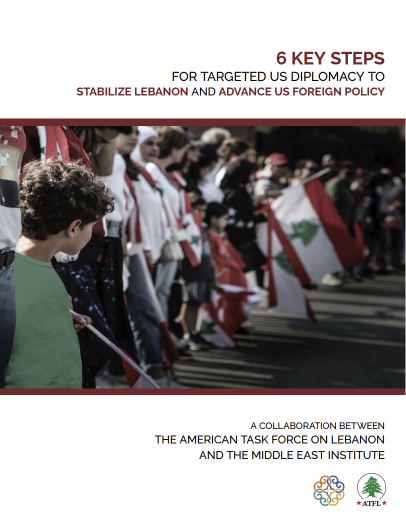
- Securing an IMF Program: Highlighted as a core pillar in ATFL's 6 Key Steps for Targeted US Diplomacy, transitioning from the 2022 Staff-Level Agreement to a full International Monetary Fund (IMF) program remains the only mechanism to unlock international macroeconomic support, restore global confidence, and begin repairing the shattered banking sector.
- Digital Financial Infrastructure: To dismantle the parallel economy, ATFL explicitly warns against the expansion of cash-based systems that empower illicit networks. The state must incentivize the transition back to formal channels by supporting secure, transparent digital payment systems and e-wallets that bypass legacy vulnerabilities while ensuring strict anti-money laundering (AML) compliance.
Lebanon cannot rebuild on a foundation of physical cash. True recovery begins the moment institutional trust is restored through transparency, accountability, and the rule of law.